My new job follows a 5.5-day workweek, so I still have to go to work on Saturday mornings. I have always found this attendance system utterly baffling. They could clearly reduce the lunch break by half an hour, or delay the end of the workday by half an hour. I would even accept starting work half an hour earlier. Yet the company chose the most baffling approach of all: keeping the workday at 7.5 hours every day, then putting the remaining 0.5*5 hours on Saturday morning, euphemistically claiming that this complies with the labor law’s eight-hour workweek.
I had originally planned to continue tinkering with the PIM system in the morning, but a colleague’s App project cut in line. He even got an Android phone specifically for me to debug with, but that phone was difficult to use: the adb connection to the computer frequently dropped and had to be reconnected. After working on it for quite a while, I still didn’t make any particularly notable progress. There wasn’t much time left in the morning, so I stopped and figured I would continue working on it next Monday—using Expo to refactor it—and bring a more reliable Android device to the office for debugging.
In the afternoon, I returned to my rental place and originally wanted to continue researching Expo, but I discovered that debugging iOS devices on macOS requires installing XCode. I have always resisted this cumbersome development software, and unless absolutely necessary, I am not going to install it on my MacBook. So I left it at that. I’ll go back to the office and tinker with it next week. In any case, Android Studio is already installed on the company computer, so I can use adb for on-device debugging simply by plugging in a data cable.
The A-share market was closed today since it was the weekend, so I browsed Tonghuashun out of boredom and saw that a post I made yesterday had become popular!
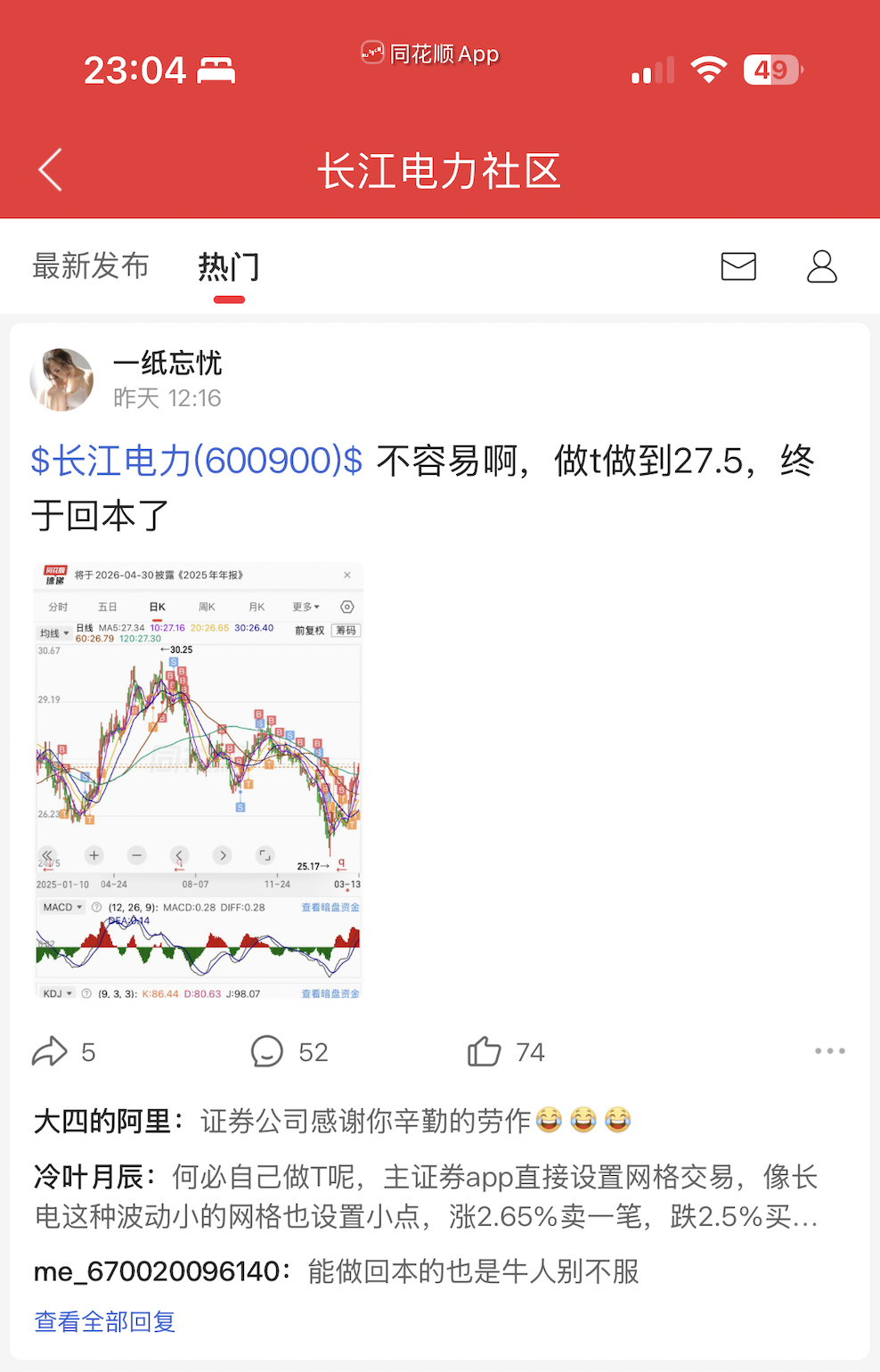
It was the one about finally breaking even on Yangtze Power last time. I held it for about a year, building my position from 26 yuan and continually adding until my cost exceeded 30 yuan. What happened afterward was that Yangtze Power took more than 20 billion yuan out for public welfare, diluting shareholders’ returns. It could be called a black swan event among public utility stocks. The share price then fell all the way down, nearly breaking below 25 yuan, while I kept adding to my position and trading T during the process to lower my cost.
I was quite happy to finally break even, and it was interesting to see the post become popular and spark discussion, but one comment caught my attention.

It reminded me that XL had previously expressed exactly the same view: roughly speaking, you shouldn’t keep holding on to a losing stock; you should cut your losses in time and move into other stocks, because you might have already made back the money there, or even earned more.
I actually can’t agree with that entirely. Although I also believe that cutting losses in time is very necessary, it depends on what kind of asset it is. For a stock like Yangtze Power, with low odds of loss and a high probability of success, and a company with an extremely deep moat, its price is bound to rise over a sufficiently long period.
By contrast, so-called market themes and hot sectors can very easily leave you stuck at the top if you chase them. Once the tide goes out and prices fall, no one knows how many retail investors will end up trapped, and many small companies also face the risk of being delisted.
Later, we also stopped communicating because our philosophies were incompatible. Thinking about it, that’s quite a shame. After finally waiting for Yangtze Power to break even, I wasn’t able to share that happiness with him.